The Kitáb-i-Íqán
The Book of Certitude — what it is, and where it comes from
Part One
Welcome
Introductions
- Your name
- Where you’re from
- Something you’re looking forward to this year
- What do you hope to get from this space?
- What do you hope to give to this space?
Goals of the study
- To strengthen the habit of reading the Writings by yourself
- To advance in your understanding of fundamental Bahá’í beliefs, and how to explain them to others
- To experience the joy of reading the Sacred Writings
Format of the study
Each session there will be time for:
- Understanding and reflecting on the paragraphs assigned for that week, and selected supplementary material related to the themes of those paragraphs
- Exploring any questions that came up during your reading or during the last week’s discussion
- Further resources are posted for anyone who wants to follow a topic further. They are not required reading.
Group norms and expectations
- To contribute to an open and welcoming environment, and to respect everyone in the group
- To come having read the paragraphs, having made an honest attempt to engage with the text and reflect on its meaning
- To ask the questions you actually have, and to respond to what others say
And
You are not expected to understand everything we read. That is why we study together.
Part Two
What is the Book of Certitude?
A Book revealed in answer to a question
The Kitáb-i-Íqán — the Book of Certitude — was revealed by Bahá’u’lláh in Baghdád in 1862, in response to questions posed by one of the maternal uncles of the Báb.
It was translated by Shoghi Effendi and first published in English in 1931.
Revealed within the space of two days and two nights, in the closing years of that period (1278 A.H.–1862 A.D.). It was written in fulfillment of the prophecy of the Báb, Who had specifically stated that the Promised One would complete the text of the unfinished Persian Bayán.
Shoghi Effendi
The manuscript
- Over two hundred pages, revealed in the space of two days and two nights
- Revealed in Persian, with Arabic quotations, verses from the Qur’án and traditions of Islám
- Transcribed by ʻAbdu’l-Bahá, then eighteen years of age, in His own hand
- In the margins of several pages, Bahá’u’lláh made corrections in His own hand
Part Three
Where it comes from
Baghdád, 1853–1863
The life of Bahá’u’lláh
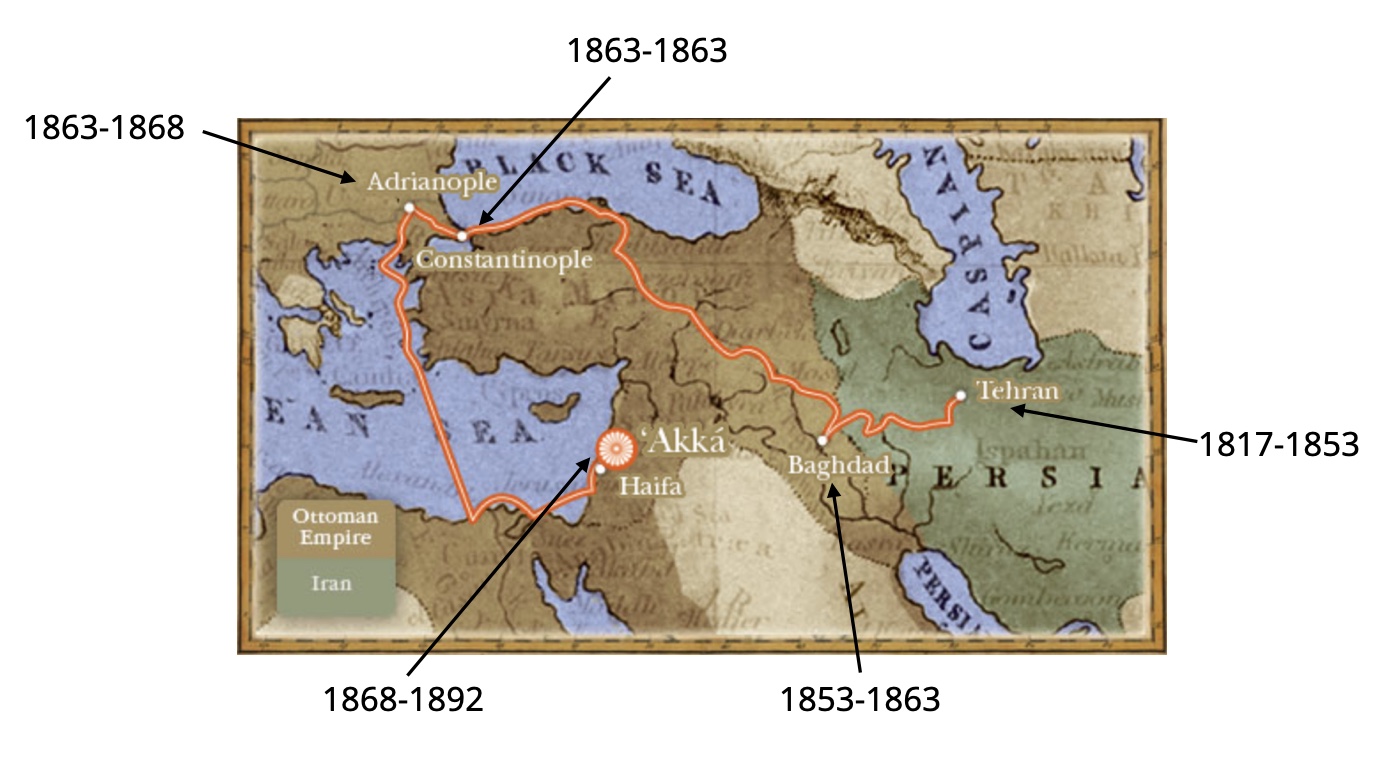
Bahá’u’lláh’s successive places of exile, with the years He spent in each
Before Baghdád
- May 1844 — the Báb declares His Mission in Shíráz
- 1844 — the message reaches Bahá’u’lláh in Ṭihrán. He accepts it at once and becomes the Cause’s foremost champion
- Early 1850 — Khál-i-Aʻẓam, the Báb’s maternal uncle, is executed among the Seven Martyrs of Ṭihrán
- 9 July 1850 — the Báb is executed in Tabríz, in His thirty-first year and the seventh of His ministry
- August–December 1852 — four months in the Síyáh-Chál, an abandoned underground reservoir beneath Ṭihrán. There, in chains, Bahá’u’lláh receives the first intimation of His own Revelation — and keeps it concealed
Into exile
- 12 January 1853 — banished from Persia, He departs Ṭihrán in midwinter with His family, including His nine-year-old son ʻAbdu’l-Bahá
- 8 April 1853 — they arrive in Baghdád, the Abode of Peace, which Bahá’u’lláh would designate the “City of God”
- 10 April 1854 — rather than contend with His half-brother and divide a community already in confusion, He leaves alone and unannounced for the mountains of Kurdistán
- 19 March 1856 — He returns, and sets about reviving the Bábí community
The years of the Book
- 1858 — the Hidden Words, composed as He paced the banks of the Tigris
- 1856–1863 — the Seven Valleys, His principal mystical work
- 1862 — the Kitáb-i-Íqán, revealed in two days and two nights
- 22 April – 3 May 1863 — ordered to Constantinople, He stays twelve days in the Najíbíyyih Garden — now the Garden of Riḍván — and declares His Mission publicly for the first time
The Íqán belongs to the last months before that declaration.
What He found in Baghdád
The community had suffered a serious blow from the repression that followed the attempt on the life of the Sháh. Baghdád had been blessed by the teaching of Ṭáhirih — yet Bahá’u’lláh found among the inhabitants no more than a single Bábí, and in Káẓimayn a mere handful who still professed their faith “in fear and obscurity.”
The Báb had been executed. Bahá’u’lláh had been imprisoned and banished. The ablest of the believers had been killed.
The fire of the Cause of God had been well-nigh quenched in every place. I could detect no trace of warmth anywhere.
Nabíl, travelling through Khurásán
A community without a voice
- No voice it could trust to resolve its questions or tell it what its duty was — sunk, Shoghi Effendi writes, in a distress that “stifled their spirit, confused their minds and strained to the utmost their loyalty”
- In Qazvín, the community had split into four mutually hostile factions
- In time twenty-five men would claim to be the Promised One foretold by the Báb
Such was the “waywardness and folly” of the community that, on His release from prison, Bahá’u’lláh’s first decision was “to arise … and undertake, with the utmost vigor, the task of regenerating this people.”
The first crisis was internal
The danger of the early Baghdád years was not external opposition. The enemies of the Faith were, for the moment, quiescent — exhausted by the bloodshed and restrained by orders from the Grand Vizir.
The crisis that overshadowed those first years in ʻIráq was “purely internal in character,” and “occasioned solely by the acts, the ambitions and follies of those who were numbered among His recognized fellow-disciples.”
Its central figure was Bahá’u’lláh’s half-brother Mírzá Yaḥyá, whom the Báb had nominated as figurehead of the community — prizing titles such as Ṣubḥ-i-Azal (Morning of Eternity) while living in hiding under an assumed name as a cotton-seller, “closeted most of the time in his house.” Behind him stood Siyyid Muḥammad of Iṣfahán, whom Bahá’u’lláh later stigmatized as the “source of envy and the quintessence of mischief.”
What the campaign looked like
- Insinuations that Bahá’u’lláh was a usurper and a subverter of the Báb’s laws
- His letters and commentaries covertly misrepresented
- Conduct that brought the public image of the Faith into disrepute
- An attempt on His life set afoot, though it came to nothing
The days of tests are now come. Oceans of dissension and tribulation are surging.… God, however, will establish His Faith, and manifest His light albeit the stirrers of sedition abhor it.
Bahá’u’lláh
The withdrawal
Discerning, as He says in the Íqán, “the signs of impending events,” He decided to withdraw before they arrived. On 10 April 1854, without telling anyone, He left Baghdád with a single attendant — who was killed by thieves shortly afterwards. From then on He was alone.
Coarsely clad, carrying nothing but an alms-bowl and a change of clothes, and giving His name as Darvísh Muḥammad, He lived for a time on the mountain of Sar-Galú, in a stone shelter the peasants visited only twice a year, at sowing and at harvest.
The one object of Our retirement was to avoid becoming a subject of discord among the faithful, a source of disturbance unto Our companions, the means of injury to any soul, or the cause of sorrow to any heart. … Our withdrawal contemplated no return, and Our separation hoped for no reunion.
Bahá’u’lláh, Kitáb-i-Íqán ¶278
Kurdistán
Discovered at last through a specimen of His penmanship, He was drawn into the seminary at Sulaymáníyyih — where He resolved the doctors’ perplexities over Ibn ʻArabí’s Futúḥát-i-Makkíyyih, a book He told them He had never seen, and at their request dictated two thousand verses in the exacting metre of Ibn-i-Fáriḍ, permitting them to keep one hundred and twenty-seven of them. These are known as the Ode of the Dove.
In a short time, Kurdistán was magnetized with His love. During this period Bahá’u’lláh lived in poverty. His garments were those of the poor and needy. His food was that of the indigent and lowly. An atmosphere of majesty haloed Him as the sun at midday.
ʻAbdu’l-Bahá
Two years away
The absence was especially hard on the community. Mírzá Yaḥyá directed a campaign by letter to discredit Bahá’u’lláh, sent a man to murder Dayyán, and ordered the secret killing of the Báb’s cousin Mírzá ʻAlí-Akbar. Siyyid Muḥammad’s band of ruffians robbed pilgrims in Karbilá and stripped the shrine of the Imám Ḥusayn. Out of shame, Bábís hardly dared appear in public.
But for My recognition of the fact that the blessed Cause of the Primal Point was on the verge of being completely obliterated, and all the sacred blood poured out in the path of God would have been shed in vain, I would in no wise have consented to return to the people of the Bayán.
Bahá’u’lláh, to Shaykh Sulṭán
The turning point
He returned on 19 March 1856, exactly two lunar years after He had left. What He found He described as “no more than a handful of souls, faint and dispirited, nay utterly lost and dead. The Cause of God had ceased to be on any one’s lips, nor was any heart receptive to its message.”
The tide of the fortunes of the Faith, having reached its lowest ebb, was now beginning to surge back.
Shoghi Effendi
In the seven years that followed, a re-arisen community took shape around a fixed and accessible centre — something the Faith had not possessed since its first three years.
A community remade
The community grew in number and in reputation. Through Bahá’u’lláh’s guidance its character and conduct improved, and He established a high standard of rectitude of conduct — a standard to which souls joyously assisted each other to acquiesce.
We exhorted all men … and forbade them to engage in sedition, quarrels, disputes or conflict. As a result of this, and by the grace of God, waywardness and folly were changed into piety and understanding, and weapons of war converted into instruments of peace.
Bahá’u’lláh
The house in the Karkh quarter
An extremely modest residence, known then simply as “the house of Mírzá Músá, the Bábí,” and later designated the Bayt-i-Aʻẓam, the Most Great House. It became the focal centre for a great number of seekers, visitors and pilgrims.
- Ṣúfí shaykhs of the Qádiríyyih and Khálidíyyih orders, come from Sulaymáníyyih with the name Darvísh Muḥammad on their lips
- The Muftí of Baghdád, Ibn-i-Álúsí, and other divines of the city, who came to test Him and enrolled among His admirers
- Government officials, Persian princes in exile, and Bábís whose only object was to attain His presence — among them four of the Báb’s cousins and his maternal uncle
- Colonel Sir Arnold Burrowes Kemball, the British consul-general, who offered Him British citizenship and to carry any message to Queen Victoria — an offer He declined
Low-roofed, it yet seemed to reach to the stars, and though it boasted but a single couch, fashioned from the branches of palms, whereon He Who is the King of Names was wont to sit, it drew to itself, even as a loadstone, the hearts of the princes.
Nabíl, on the reception room of the Most Great House
I know not how to explain it. Were all the sorrows of the world to be crowded into my heart they would, I feel, all vanish, when in the presence of Bahá’u’lláh. It is as if I had entered Paradise itself.
Zaynu’l-ʻÁbidín Khán, the Fakhru’d-Dawlih
“A copious rain”
Nabíl, living in Baghdád at the time, testified that in the first two years after the return the unrecorded verses that streamed from His lips averaged, in a single day and night, the equivalent of the Qur’án.
A great proportion was deliberately destroyed. By His own order, hundreds of thousands of verses, mostly in His own hand, were obliterated and cast into the river. When His amanuensis hesitated, He reassured him:
None is to be found at this time worthy to hear these melodies.
Bahá’u’lláh
What survives from Baghdád
- The Kitáb-i-Íqán (1862)
- The Hidden Words (1857–8), originally designated the Hidden Book of Fáṭimih
- The Seven Valleys (c. 1856–1863), written in answer to the questions of Shaykh Muḥyi’d-Dín, the Qáḍí of Khániqayn
- The Four Valleys, addressed to Shaykh ʻAbdu’r-Raḥmán-i-Karkúkí — one of the Kurdish leaders who had known Him as Darvísh Muḥammad
- The Tablet of the Holy Mariner, the Ode of the Dove, the Tablet of Patience, the Gems of Divine Mysteries, and a host of commentaries, odes and prayers
Part Four
The occasion
One man’s questions, and the Book that answered them
The three maternal uncles of the Báb
Brothers of His mother, Fatima-Begum.
Hájí Mírzá Siyyid Muḥammad Khál-i-Akbar · the Greater Uncle The eldest of the three, and the recipient of the Íqán.
Hájí Mírzá Siyyid ʻAlí Khál-i-Aʻẓam · the Greatest Uncle The middle brother. Raised and cared for the Báb from childhood after His father’s passing. Recognized His station at once and was the first to declare his faith after the Letters of the Living. Martyred as one of the Seven Martyrs of Ṭihrán.
Hájí Mírzá Siyyid Ḥasan ʻAlí Khál-i-Aṣghar · the younger uncle The youngest of the three brothers.
The admirer who could not believe
Before His declaration, the Báb was in Bushihr, occupied in business with His three uncles. He left for Shíráz accompanied by Khál-i-Aʻẓam, and declared His Mission there in 1844.
Khál-i-Akbar continued to run the family business at Bushihr. Travelling to Mecca and returning, the Báb stayed at this uncle’s home — and the uncle witnessed a great transformation of spirit in his Nephew.
[I am] pleased to be in the presence of his Nephew Whose bountiful soul is the source of felicity for the people of the world and the next.
Khál-i-Akbar, writing to the Báb’s mother
And yet he never accepted Him as the Promised One of Islám — not until he met Bahá’u’lláh in Baghdád in 1862. Several believers had tried to dispel his doubts, without success: he did not believe his Nephew had fulfilled certain Islamic traditions.
The journey to Baghdád
- 1850 — the martyrdom of the Báb and of His uncle Khál-i-Aʻẓam brings immense grief to the family. Fatima-Begum, unable to remain in Shíráz, takes up residence in Karbilá.
- Agha Mirza Nurud-Din, of the Afnán family, in a series of discussions persuades Khál-i-Akbar to travel to Baghdád, meet Bahá’u’lláh, and put his questions to Him directly.
- He invites his younger brother to accompany him on pilgrimage to the Shrines of Iraq — but does not tell him the real purpose until they arrive. His brother, on hearing it, speaks very harshly to him.
- So they visit the Shrines first. It is on the return to Baghdád that he is taken to the house of Bahá’u’lláh, where he attains His presence alone.
“Bring me your questions”
Overwhelmed and uplifted as he sat in His presence, Khál-i-Akbar asked Bahá’u’lláh to clarify the truth of the Báb’s Message — presuming in his mind that certain traditions of Islám concerning the Promised Qá’im had not been fulfilled by his Nephew.
Bahá’u’lláh readily consented, and bade him go home, consider carefully, and make a list of the questions that had puzzled him together with all the Islamic traditions that had bred his doubts.
Afterwards the uncle wrote to his son of his wonder — and of his regret that people who miss being in Bahá’u’lláh’s bounteous presence are at a grievous loss.
The four questions
The questions were written on two sheets in his own hand, under four headings — all dealing with the coming of the Promised Qá’im.
- The Day of Resurrection. Is there to be a corporeal resurrection? The world is replete with injustice — how are the just to be requited and the unjust punished?
- The twelfth Imám was born at a certain time and lives on. There are traditions, all supporting the belief. How can this be explained?
- Interpretation of the holy texts. This Cause does not seem to conform to the beliefs held throughout the years. One cannot ignore the literal meaning of the holy texts and scriptures.
- Certain events must occur at the advent of the Qá’im, according to the traditions handed down from the Imáms. But none of these has happened. How can this be explained?
Two days and two nights
Within two days and two nights the Kitáb-i-Íqán was revealed, answering all of his questions — and solving, along the way, a great many misunderstood and misinterpreted questions belonging to all religions.
The Book dispelled every doubt Khál-i-Akbar had harboured. He reached the stage of certitude and recognized the station of the Báb. Later he also accepted Bahá’u’lláh as “Him Whom God shall make manifest” — as was confirmed in his will.
The point
A book written to answer one man’s honest doubts turned out to answer the doubts of everyone who would come after him.
Part Five
Why should we study it?
In fact, all the Scriptures and the mysteries thereof are condensed into this brief account. So much so, that were a person to ponder it a while in his heart, he would discover from all that hath been said the mysteries of the Words of God, and would apprehend the meaning of whatever hath been manifested by that ideal King.
Bahá’u’lláh
Shoghi Effendi on the Íqán
The Iqan is the most important book written on the spiritual significance of the Cause. I do not believe any person can consider himself well versed in the teachings unless he has studied it thoroughly.
The book is so important that the most minute detail is worthy of consideration.
Of special importance is the Book of the Iqán which explains the attitude of the Cause towards the prophets of God and their mission in the history of society.
A key, not a conclusion
The Sacred Books are full of allusions to this new dispensation. In the book of Iqán, Bahá’u’lláh gives the key-note and explains some of the outstanding passages hoping that the friends will continue to study the Sacred Books by themselves and unfold the mysteries found therein.
Shoghi Effendi
The one who ponders over that book and grasps its full significance will obtain a clear insight into the old scriptures and appreciate the true mission of the Báb and Bahá’u’lláh.
Shoghi Effendi
Part Six
What is inside
Shoghi Effendi’s overview
Its place in the Writings
Foremost among the priceless treasures cast forth from the billowing ocean of Bahá’u’lláh’s Revelation ranks the Kitáb-i-Íqán.
A model of Persian prose, of a style at once original, chaste and vigorous, and remarkably lucid, both cogent in argument and matchless in its irresistible eloquence.
Setting forth in outline the Grand Redemptive Scheme of God, [it] occupies a position unequalled by any work in the entire range of Bahá’í literature, except the Kitáb-i-Aqdas, Bahá’u’lláh’s Most Holy Book.
Revealed on the eve of the declaration of His Mission, it proffered to mankind the “Choice Sealed Wine,” whose seal is of “musk,” and broke the “seals” of the “Book” referred to by Daniel.
Within a compass of two hundred pages
- Proclaims the existence and oneness of a personal God — unknowable, inaccessible, the source of all Revelation, eternal, omniscient, omnipresent and almighty
- Asserts the relativity of religious truth and the continuity of Divine Revelation
- Affirms the unity of the Prophets, the universality of their Message, the identity of their fundamental teachings, the sanctity of their scriptures, and the twofold character of their stations
- Denounces the blindness and perversity of the divines and doctors of every age
- Cites and elucidates the allegorical passages of the New Testament, the abstruse verses of the Qur’án, and the cryptic Muḥammadan traditions
- Enumerates the essential prerequisites for the attainment by every true seeker of the object of his quest
- Demonstrates the validity, the sublimity and significance of the Báb’s Revelation
- Unfolds the meaning of such symbolic terms as “Return,” “Resurrection,” “Seal of the Prophets” and “Day of Judgment”
- Distinguishes between the three stages of Divine Revelation
- Expatiates upon the glories and wonders of the “City of God”
The claim
Well may it be claimed that of all the books revealed by the Author of the Bahá’í Revelation, this Book alone, by sweeping away the age-long barriers that have so insurmountably separated the great religions of the world, has laid down a broad and unassailable foundation for the complete and permanent reconciliation of their followers.
Shoghi Effendi
The road ahead
Thirteen sessions. Paragraphs 1 through 290. From the conditions of the true seeker, through the symbolic language of “oppression” and “sun, moon and stars,” through resurrection and return and the twofold station of the Manifestations, to the proofs of the Revelation of the Báb.
For next week: paragraphs 1–23.
They that tread the path of faith, they that thirst for the wine of certitude, must cleanse themselves of all that is earthly.
Bahá’u’lláh, Kitáb-i-Íqán ¶2
Kitáb-i-Íqán Study