Week 1
9 September 2026
Introductions
- Your name
- Where you’re from
- Something you’re looking forward to this year
- What do you hope to get from this space?
- What do you hope to give to this space?
Goals of the study
- To strengthen the habit of reading the Writings by yourself
- To advance in your understanding of fundamental Bahá’í beliefs, and how to explain them to others
- To experience the joy of reading the Sacred Writings
Format of the study
Each session there will be time for:
- Understanding and reflecting on the paragraphs assigned for that week, and selected supplementary material related to the themes of those paragraphs
- Exploring any questions that came up during your reading or during the last weeks’ discussion
- Further resources are posted for anyone who wants to follow a topic further. They are not required reading.
Group norms and expectations
- To contribute to an open and welcoming environment, and to respect everyone in the group.
- To come having read the paragraphs, having made an honest attempt to engage with the text and reflect on its meaning.
- To ask any questions that you have about the material and respond to comments or questions that others make
- To be open to changing your mind
- You are not expected to understand everything we read. That is why we study together.
What is the Book of Certitude?
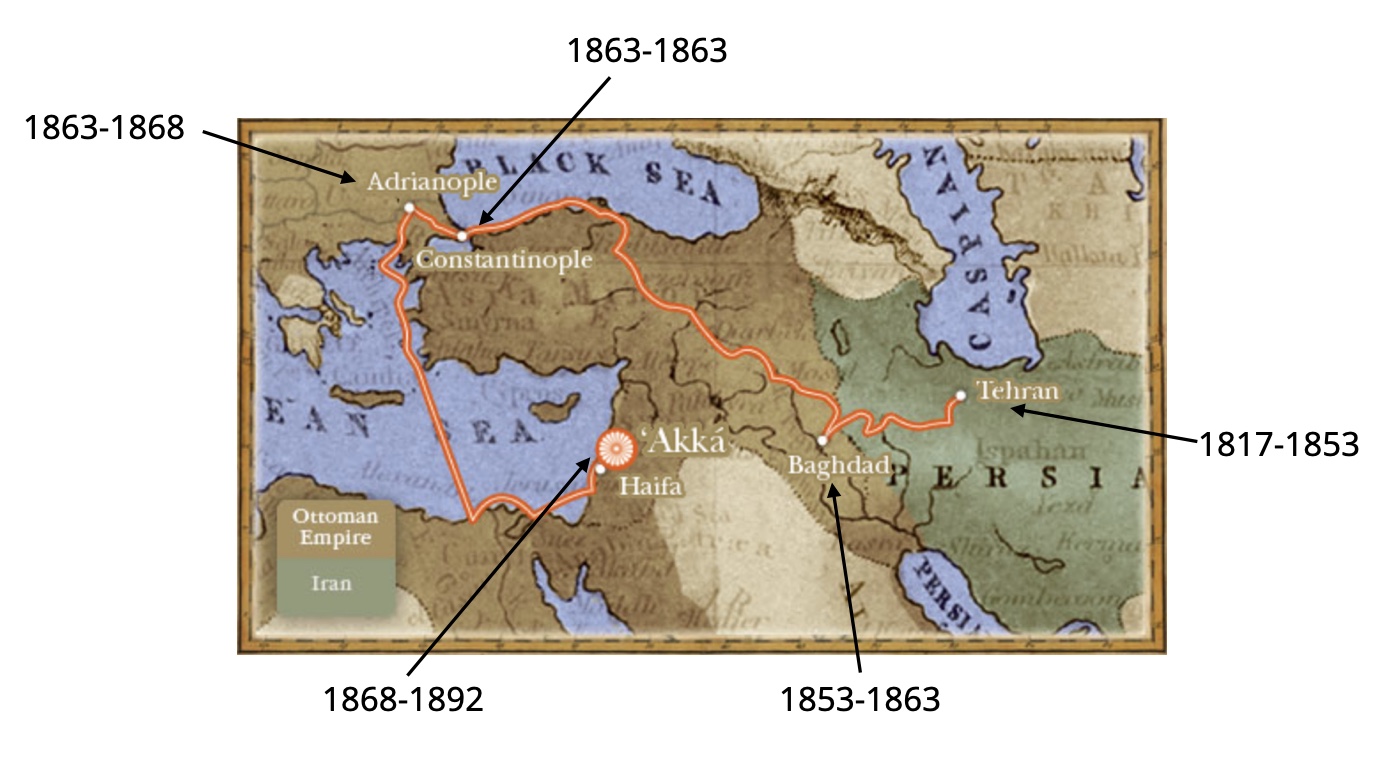
The Kitáb-i-Íqán: The Book of Certitude is a Book revealed by Bahá’u’lláh in Baghdad in 1862 in response to questions posed by one of the maternal uncles of the Báb, translated by Shoghi Effendi and first published in English in 1931.
The Life of Bahá’u’lláh (recap)
The three maternal uncles of the Báb
The Báb had three maternal uncles; they were brothers of His mother, Fatima-Begum:
- Hájí Mírzá Siyyid Muhammad was the eldest of the three brothers and the recipient of the Íqán.
- Haji Mirza Siyyid Ali was the middle brother:
- He was the one who was responsible for the upbringing and caring of the Báb from His childhood, after the passing of His father.
- Having witnessed the spiritual and superhuman qualities in his Nephew all along from His childhood, this uncle readily recognized the station of the Báb and became an ardent believer soon after His Declaration. He was the first to declare his faith after The Letters of Living, as a promoter of the new religion as well as a protector of its Founder.
- As a result of refusing to recant his faith, he was publicly martyred as one of the seven Martyrs of Tehran, a few months before the martyrdom of the Báb.
- Haji Mirza Siyyid Hassan Ali was the youngest of the three brothers.
Circumstances surrounding the revelation of the Book
Before His declaration in Shiraz, the Báb was in Bushier occupied in a business with His three uncles. The Báb left Bushier for Shiraz accompanied by Khal-i-Azam, Haji Mirza Siyyid Ali (the middle uncle). The Báb declared His Mission in Shiraz in 1844 A.D.
Haji Mirza Siyyid Muhammad (the eldest uncle) continued to run the family business in Bushier together with his younger brother, Haji Mirza Hasan Ali (the younger uncle). After His declaration, the Báb went to Mecca via Bushier where He stayed at the home of this uncle. Returning from Mecca, again He stayed at His uncle’s home in Bushier. Haji Mirza Siyyid Muhammad witnessed a great transformation of spirit in the Báb and wrote to his sister, the Báb’s mother, Fatima-Begum, expressing that he was “pleased to be in the presence of his Nephew Whose bountiful soul is the source of felicity for the people of the world and the next.”
Though a great admirer of his Nephew, Haji Mirza Siyyid Muhammad never accepted Him as the Promised One of Islám until he met Bahá’u’lláh in Baghdad, in 1862. Before then, in Iran, several believers tried to convince him of the truth of this New Faith, but he refused to accept it as he did not believe his Nephew had fulfilled certain Islamic traditions.
The martyrdom of the Báb and His uncle Haji Mirza Siyyid Ali in 1850 brought immense grief and shock to the members of the family. Fatima-Begum, the Báb’s mother, could not bear to stay in her home in Shiraz anymore. She travelled to Iraq and took up residence in Karbala to be near the shrine of Imám Hussein.
After His declaration, most of the relatives of the Báb, including His wife, Khadíjah-Begum and His uncle, Haji Mirza Siyyid Ali who had realized His Station from His early age, readily became His followers. Thousands of believers (Bábís) laid down their lives in His path, but the eldest and the youngest uncles, Haji Mirza Siyyid Muhammad and Haji Mirza Hassan Ali, respectively, were not yet convinced of His Station as a Prophet of God.
Several Bábís had tried to dispel Haji Mirza Siyyid Muhammad’s doubts about the Báb’s Station, without success. Agha Mirza Nurud-Din, a believer from the Afnan family, in a series of discussions with him, convinced this uncle to travel to Baghdad in Iraq, meet with Bahá’u’lláh and ask Him the questions about which he had doubts. On this journey, he would also visit his sister, Fatima Begum, and the Shrines in Karbala, Najaf, Kazimayn and Samarra where some of the Imáms of Shi’i Islám including Imám Husayn are buried. Haji Mirza Siyyid Muhammad agreed to this suggestion and invited his younger brother, Haji Mirza Hasan Ali to accompany him on pilgrimage to the Shrines in Iraq, but he did not tell him the real purpose of his visit to Bahá’u’lláh until they arrived in Baghdad. On hearing about this, Haji Mirza Hasan Ali got angry and although younger than him spoke very harshly to him, so he decided to go with his younger brother to the Shrines first. It was on his return to Baghdad that he was taken by Haji Mirza Javad-i-Karbala’i to the house of Bahá’u’lláh where he attained His presence alone.
Upon meeting Bahá’u’lláh, Haji Mirza Siyyid Muhammad was overwhelmed and uplifted as he sat in His presence and listened to His utterances. He asked Bahá’u’lláh to clarify the truth of the Báb’s Message, presuming in his mind that some of the traditions of Islám concerning the Promised Qá’im were apparently not fulfilled by his Nephew. To this Bahá’u’lláh readily consented and bade him go home and after careful consideration, make a list of the questions that had puzzled him together with all the Islamic traditions that had brought doubts in his mind and bring these to Him. After meeting with Bahá’u’lláh, Haji Mirza Siyyid Muhammad was so affected that he wrote to his son, Haji Mirza Muhammad Taqi, expressing his wonder and regret that people who miss being in Bahá’u’lláh’s bounteous presence are at a grievous loss.
The questions
The following day, Haji Mirza Siyyid Muhammad arrived with his questions. The questions that Haji Mirza Siyyid Muhammad presented to Bahá’u’lláh were written on two sheets in his own hand and they are under four headings, all dealing with the coming of the Promised Qá’im. They are summarized as follows:
- The Day of Resurrection. Is there to be a corporeal resurrection? The world is replete with injustice. How are the just to be requited and the unjust punished?
- The twelfth Imám was born at a certain time and lives on. There are traditions, all supporting the belief. How can this be explained?
- Interpretation of the holy texts. This Cause does not seem to conform to the beliefs held throughout the years. One cannot ignore the literal meaning of the holy texts and scriptures. How can this be explained?
- Certain events, according to the traditions that have come down from the Imáms, must occur at the advent of the Qá’im. Some of these are mentioned. But none of these has happened. How can this be explained?
Within two days and two nights, the Kitáb-i-Íqán was revealed by Bahá’u’lláh responding to all of his questions. It was revealed in Persian, with some Arabic quotations, verses from the Qur’án and traditions of Islám, as well as numerous other references to solving many misunderstood and misinterpreted questions related to all Religions.
This lengthy Epistle [Book] of over two hundred pages was transcribed by ʻAbdu’l-Bahá, then 18 years of age, in His own hand. In the margins of several of the pages, Bahá’u’lláh has in His own hand made some corrections.
The Kitáb-i-Íqán dispelled every doubt that Haji Mirza Siyyid Muhammad had harboured in his mind. As a result of reading, he reached the stage of Certitude and recognized the station of the Báb. Later he also accepted Bahá’u’lláh as “Him Whom God shall make manifest”, as was confirmed in his will.
Why study the Book of Certitude?
In fact, all the Scriptures and the mysteries thereof are condensed into this brief account. So much so, that were a person to ponder it a while in his heart, he would discover from all that hath been said the mysteries of the Words of God, and would apprehend the meaning of whatever hath been manifested by that ideal King.
Bahá’u’lláh
The Iqan is the most important book written on the spiritual significance of the Cause. I do not believe any person can consider himself well versed in the teachings unless he has studied it thoroughly.
Shoghi Effendi
The book is so important that the most minute detail is worthy of consideration
Shoghi Effendi
The Sacred Books are full of allusions to this new dispensation. In the book of Iqán, Bahá’u’lláh gives the key-note and explains some of the outstanding passages hoping that the friends will continue to study the Sacred Books by themselves and unfold the mysteries found therein.
Shoghi Effendi
Shoghi Effendi hoped that you will exert all your efforts first in deepening your own knowledge of the teachings and then to strive to attract other people. You should form study classes and read the Important books that have been published especially the Iqán which contains the basic tenets of the Faith. The one who ponders over that book and grasps its full significance will obtain a clear insight into the old scriptures and appreciate the true mission of the Báb and Bahá’u’lláh.
Shoghi Effendi
Shoghi Effendi hopes that you will exert all your efforts to deepen your knowledge of the literature of the Movement, until you become fully acquainted with its spirit and tenets. Unless you do obtain such a firm hold you will never be able to teach others and render real service to the promulgation of the Faith. Of special importance is the Book of the Iqán which explains the attitude of the Cause towards the prophets of God and their mission in the history of society. Besides this there is Some Answered Questions of the Master and Dawn-Breakers of Nabíl. Every Bahá’í should master these books and be able to explain their contents to others. Besides their importance, they are interesting and most absorbing.
Shoghi Effendi
Books such as the Iqán, Some Answered Questions, the Tablets of Bahá’u’lláh, Nabíl’s Narrative and Dr. Esslemont’s book should be read and read over again by every soul who desires to serve the Movement or considers himself an active member of the group.
Shoghi Effendi
More of these, with their sources, are on the home page.
Shoghi Effendi’s Overview of the Iqán
Foremost among the priceless treasures cast forth from the billowing ocean of Bahá’u’lláh’s Revelation ranks the Kitáb-i-Íqán (Book of Certitude), revealed within the space of two days and two nights, in the closing years of that period (1278 A.H.–1862 A.D.). It was written in fulfillment of the prophecy of the Báb, Who had specifically stated that the Promised One would complete the text of the unfinished Persian Bayán, and in reply to the questions addressed to Bahá’u’lláh by the as yet unconverted maternal uncle of the Báb, Ḥájí Mírzá Siyyid Muḥammad, while on a visit, with his brother, Ḥájí Mírzá Ḥasan-ʻAlí, to Karbilá. A model of Persian prose, of a style at once original, chaste and vigorous, and remarkably lucid, both cogent in argument and matchless in its irresistible eloquence, this Book, setting forth in outline the Grand Redemptive Scheme of God, occupies a position unequalled by any work in the entire range of Bahá’í literature, except the Kitáb-i-Aqdas, Bahá’u’lláh’s Most Holy Book. Revealed on the eve of the declaration of His Mission, it proffered to mankind the “Choice Sealed Wine,” whose seal is of “musk,” and broke the “seals” of the “Book” referred to by Daniel, and disclosed the meaning of the “words” destined to remain “closed up” till the “time of the end.”
Within a compass of two hundred pages it proclaims unequivocally the existence and oneness of a personal God, unknowable, inaccessible, the source of all Revelation, eternal, omniscient, omnipresent and almighty; asserts the relativity of religious truth and the continuity of Divine Revelation; affirms the unity of the Prophets, the universality of their Message, the identity of their fundamental teachings, the sanctity of their scriptures, and the twofold character of their stations; denounces the blindness and perversity of the divines and doctors of every age; cites and elucidates the allegorical passages of the New Testament, the abstruse verses of the Qur’án, and the cryptic Muḥammadan traditions which have bred those age-long misunderstandings, doubts and animosities that have sundered and kept apart the followers of the world’s leading religious systems; enumerates the essential prerequisites for the attainment by every true seeker of the object of his quest; demonstrates the validity, the sublimity and significance of the Báb’s Revelation; acclaims the heroism and detachment of His disciples; foreshadows, and prophesies the world-wide triumph of the Revelation promised to the people of the Bayán; upholds the purity and innocence of the Virgin Mary; glorifies the Imáms of the Faith of Muḥammad; celebrates the martyrdom, and lauds the spiritual sovereignty, of the Imám Ḥusayn; unfolds the meaning of such symbolic terms as “Return,” “Resurrection,” “Seal of the Prophets” and “Day of Judgment”; adumbrates and distinguishes between the three stages of Divine Revelation; and expatiates, in glowing terms, upon the glories and wonders of the “City of God,” renewed, at fixed intervals, by the dispensation of Providence, for the guidance, the benefit and salvation of all mankind. Well may it be claimed that of all the books revealed by the Author of the Bahá’í Revelation, this Book alone, by sweeping away the age-long barriers that have so insurmountably separated the great religions of the world, has laid down a broad and unassailable foundation for the complete and permanent reconciliation of their followers.
Shoghi Effendi
Before next week
Read ¶1–23, and come with what struck you and what you did not follow. The whole reading schedule is on the Schedule page.